The setting
Inside a Fes palace: tile, cedar, plaster
Why a Fes palace dinner is staged around a courtyard, and what to look for in the tile, the carved cedar and the plaster once you are inside.
Reserve your place at the table ↗An inward-facing plan
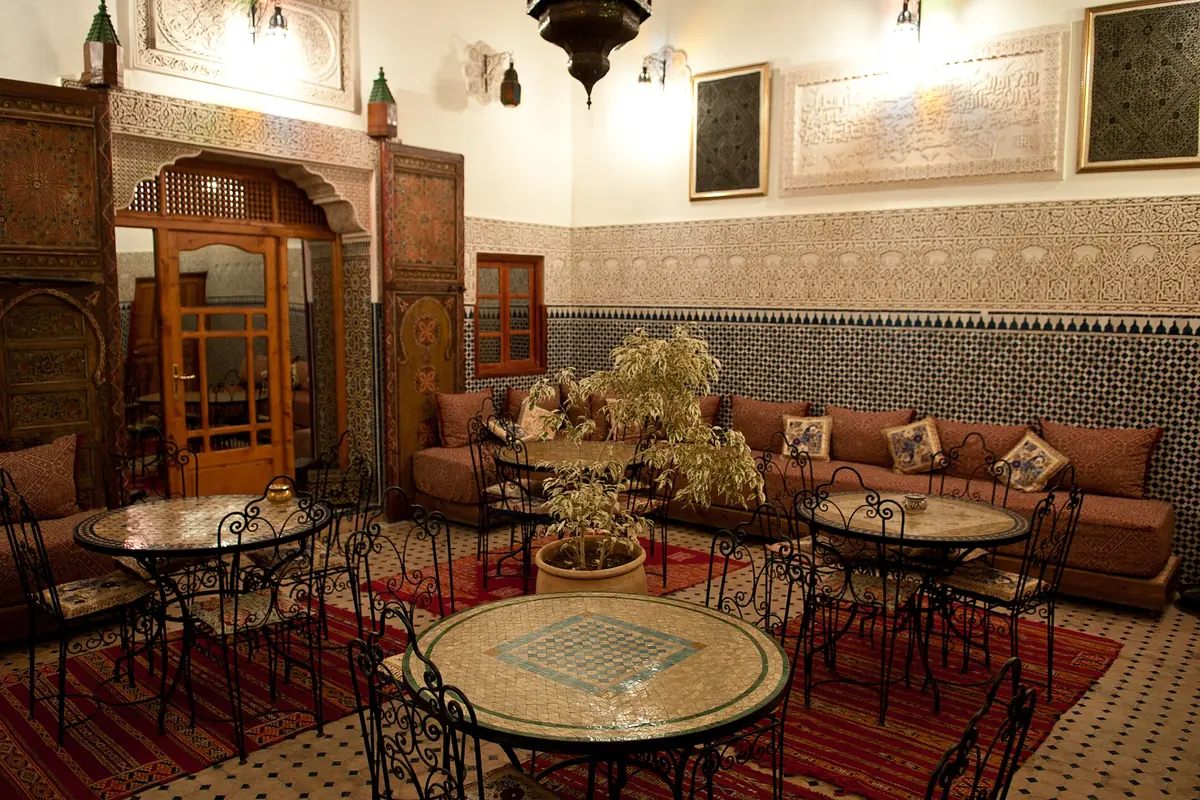
Traditional Moroccan houses are built around a courtyard, often with a gallery around it, and the rooms branch off it. Even rich mansions are usually plain on the outside, with few large windows and a bent entrance that stops anyone in the street from seeing in. All the decoration goes inside. The size and craftsmanship of the courtyard showed the status of its owners, which is why a palace dinner starts the moment you step into it.
The courtyard garden
In Morocco a riad is an interior garden found in many mansions and palaces. It is normally rectangular, divided into four parts along its central axes, with a fountain at the middle. The idea probably began in Persian architecture and reached Moorish palaces in Spain before spreading in Morocco. Today the word is also used for old houses converted into guesthouses. A palace courtyard may be a garden or a paved court with a basin.
Zellij tile
Zellij is mosaic tilework made of hand-cut pieces of glazed faience, fitted into geometric patterns that are often star-shaped. It appeared in the region in the 10th century and was widespread by the 14th, in the Marinid period. Makers glaze squares of about 10 centimetres, then cut them by hand into shapes that they have often memorised. It lines the lower walls and the floors, so as you walk across a courtyard you are standing on it.
Carved and painted cedar
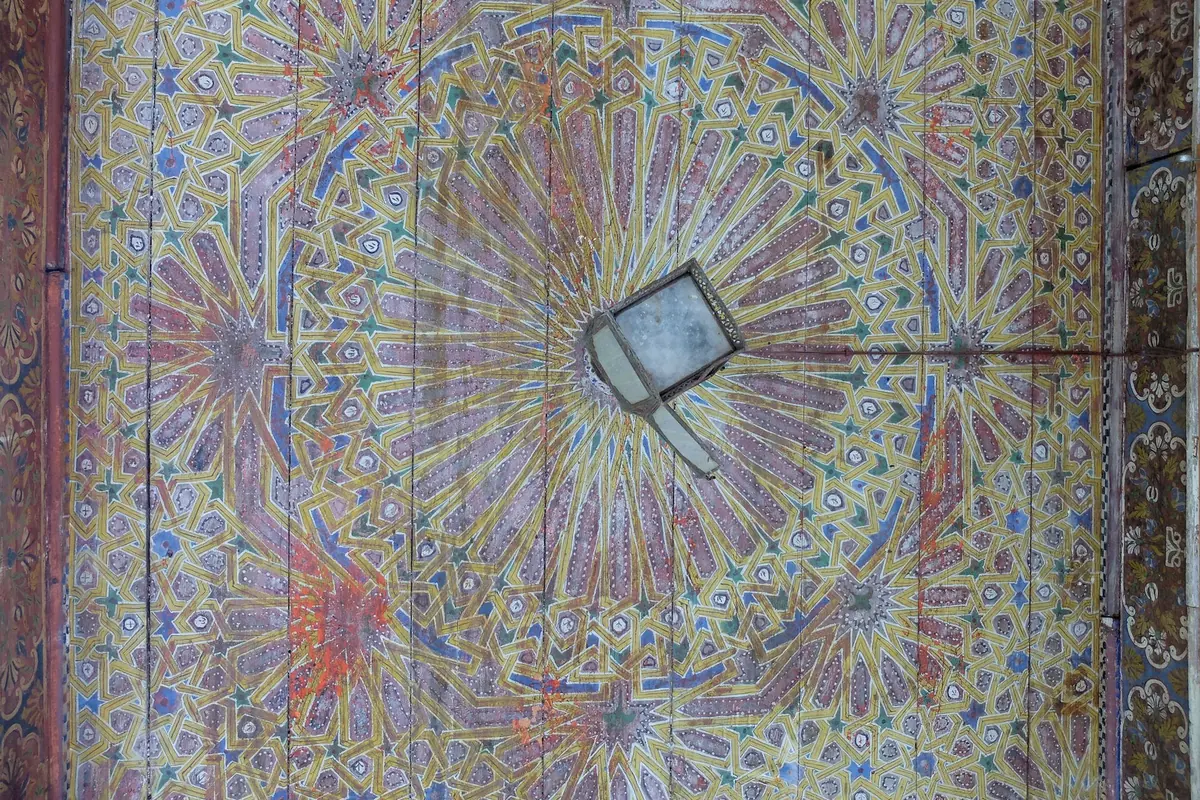
Sculpted wood became a major element of decoration from the Marinid period on. It generally came from Moroccan cedar trees, still valued and now mostly limited to the forests of the Middle Atlas. The Atlas cedar is a large conifer that can reach 30 to 35 metres, native to the Rif and Atlas mountains. In a palace, look up: carved and painted cedarwood is part of what makes these ceilings.
Carved plaster
Carved stucco is among the most distinctive elements of Moroccan architecture. It is cheap, easily sculpted, and was carved and painted with floral and vegetal arabesques, geometric patterns, calligraphy and muqarnas, the honeycomb forms. It covers walls and ceilings above the tilework. Together with the cedar it makes the room read in layers: tile at your feet, plaster at eye level and carved wood overhead.
Fes as the stage
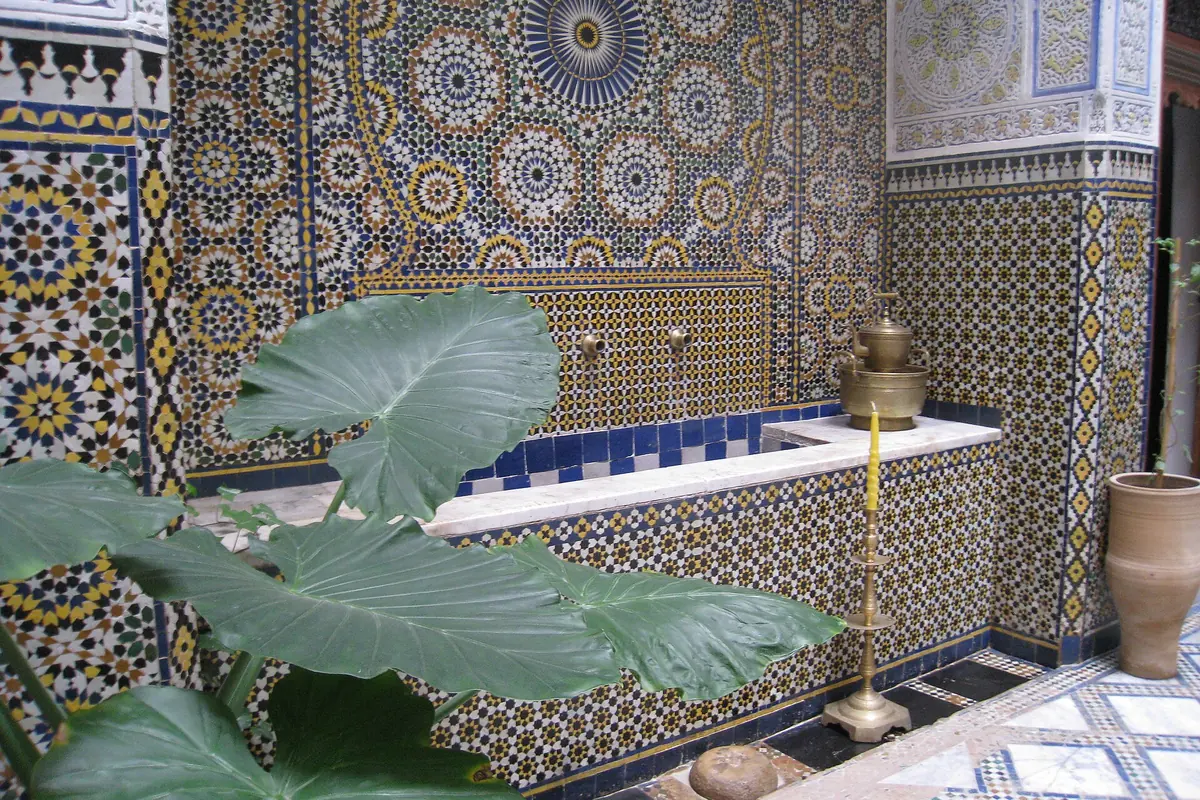
UNESCO inscribed the Medina of Fez as a World Heritage Site in 1981. Fes el Bali was founded as the Idrisid capital between 789 and 808, and the Marinids, from the 13th century, built the city’s first true madrasas, which show the same mix of tile, cedar and plaster. The medina counts as one of the most extensive and best conserved historic towns of the Arab-Muslim world. A palace dinner is a small part of that larger setting.
What to look for
Give yourself a minute at the entrance. You can look for the pattern in the floor, the way the tile climbs the lower walls and where it stops, the plaster band above it, and the wooden ceiling. Watch for the fountain, if there is one, and for the gallery, if there is one. Every palace arranges these elements in its own way, and the differences are the pleasure of looking.
Palaces of the 19th century
Many of the palaces in Fes belong to the decades around 1900. Sultan Moulay Hasan I, who reigned from 1873 to 1894, joined Fes el-Jdid and Fes el-Bali with a walled corridor that held new gardens and summer palaces for the royal family and high society, among them Dar Batha. In the same era grand viziers and other senior figures built private palaces for their households. They followed the older plan: an inward-facing house around a courtyard, decorated with tile, plaster and carved wood.
Who this isn't for
If you want to study the architecture at length, with a guide and time to climb and photograph, this is the wrong format: you are there for dinner, and the staff will be serving. Madrasas and historic houses open to visitors by day suit that better. A dinner room is for looking up between courses and then eating.
Sources