The music
Fes dinner music: oud, violin and darbuka
The three instruments you hear at a Fes palace dinner, where they come from and how they connect to the city’s older Andalusi musical tradition.
Reserve your place at the table ↗Three instruments, one band
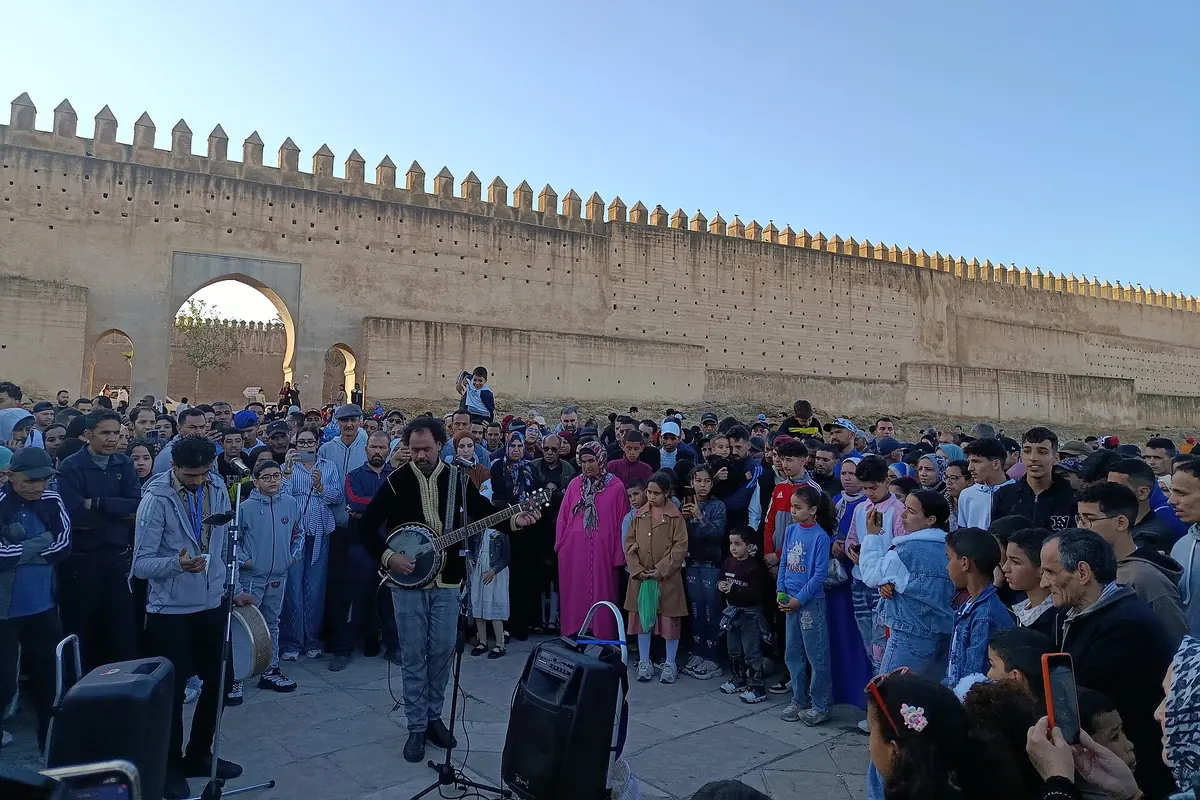
Three instruments carry the sound of the evening: the violin, the oud and the darbuka. A live folklore band plays through dinner, and the programme is the band’s to choose on the night, so no particular piece is promised. What you can count on is the sound of instruments that have been played around the Mediterranean and the Middle East for a very long time. Each does a different job: one sings the line, one plucks it, one holds the pulse.
The oud
The oud is a short-necked, pear-shaped lute with no frets, usually strung with 11 strings in six courses. Its history is long and well recorded: the 9th-century philosopher al-Kindi described its construction in an epistle, and Wikipedia notes that Western lutes developed from the medieval Islamic oud. In a folklore band it is the plucked line, the one that can carry a melody and an accompaniment at once.
The darbuka
The darbuka is a goblet drum with a single head, widely used in the traditional music of North Africa, the Middle East and the Balkans. Players hold it under one arm or rest it sideways on the lap and strike it with the fingertips and palm, which gives a resonant sound that dies away quickly. Wikipedia distinguishes two main styles: the Egyptian type has rounded edges around the head, which suits rapid rolls, while the Turkish type exposes the edge so a player can snap the fingers against the head.
The violin in a Moroccan band
The violin has a settled place in Moroccan music. The Moroccan Andalusi orchestra, as Wikipedia describes it, uses the oud, the rabab, the darbuka and the kamanja, the Arabic name for the violin. The same instruments therefore sit in two worlds at once: the concert tradition of the city and the lively folklore band that plays while you dine. The family also includes the rabab, a tambourine and the qanun.
Fes and its classical tradition
Fes is associated with the tarab al-āla style, a result of a large migration of Muslims from Valencia to the city. Scholars quoted in the Fez article prefer the name āla, which means “instrument”, to the popular label “Andalusi music”; one of them chose it to set the style apart from the purely vocal Sufi tradition. The folklore band at your table is not playing this tradition. It shares the family of instruments, and that is the link worth knowing.
What a nuba is
In the Moroccan Andalusi tradition the central form is the nuba, a suite of five parts, each with its own rhythm. Wikipedia notes that a full nuba is never performed in one sitting, which is a useful reminder of how large the repertoire is. Morocco’s tradition is also called the best documented of the Andalusi schools. None of this will be on the dinner programme, but it is the musical background of the city around the palace.
The Festival of World Sacred Music
Fes also hosts an annual Festival of World Sacred Music, which began in 1994 and presents religious music from around the world; the Fez article places it in May or June, with concerts at several venues across the city. It is a separate event with its own programme and tickets, and the dinner has no connection to it. If your trip falls in that season, it is the other way to hear Fes in song.
From Andalusia to Fes
Fes has long been a city of arrivals from al-Andalus. Wikipedia’s account of Fes el Bali says that many of the city’s first inhabitants were refugees fleeing an uprising in Cordoba, and the Fez article ties the city’s classical style to a later migration from Valencia. Andalusi music itself, the article on the tradition says, was allegedly born in the Emirate of Córdoba in the 9th century, with Ziryāb sometimes credited as its inventor. Songs and instruments travelled with the people who carried them.
Who this isn't for
If you want a concert in silence, with a programme, a pianist’s stillness and no clinking plates, this is not the evening. The band plays in a lively room for a seated dinner, and the dancers move among the tables. Anyone who wants the classical āla tradition itself should look for a dedicated concert in Fes, not a folklore dinner. The dinner is for eating, watching the dancers and letting a lively band fill the courtyard.
Sources